
The 2025-2030 Dietary Guidelines for Americans have officially been released on January 7th 2026. Along with the guidelines is a graphic called the New Food Pyramid.
While the core message remains focused on healthy eating patterns, there are some important shifts. In this article we are going to dive into the new food pyramid and dietary guidelines, focusing on what you need to know as an older adult.
What Are the 2025-2030 Dietary Guidelines?
The Dietary Guidelines for Americans (DGAs) are updated every five years by the U.S. Department of Agriculture (USDA). The guidelines are updated regularly to reflect the latest nutrition science. Because science is always changing.
The DGAs provide evidence-based recommendations for healthy eating patterns that support overall health and reduce the risk of chronic disease.
The 2025-2030 Dietary Guidelines emphasize:
- Whole, minimally processed foods
- Adequate protein at each meal
- A balance of carbohydrates, fats, and protein
- Limiting ultra-processed foods and added sugars
- Supporting long-term health rather than short-term dieting
Instead of focusing on single nutrients or “good vs. bad” foods, the guidelines encourage building a balanced dietary pattern over time.
The core messages of the guidelines include:
- Eat the Right Amount for You
- This is important, we’re all different. This is why working with a Registered Dietitian can be so beneficial.
- Prioritize Protein Foods at Every Meal
- Protein at every meal has been a message that geriatric dietitians have been promoting for as long as I can remember. Protein is a really important nutrient for older adults to promote muscle health (among other things!).
- It is important to note that the new guidelines recommend 1.2-1.6 grams of protein per kilogram body weight. This is a shift from previous guidelines which emphasized 0.8 grams of protein per kilogram body weight.
- For older adults, research suggests 1-1.2 grams of protein per kilogram body weight. See our article on Protein Requirements for Older Adults for more information.
- As with the previous message, everyone has different needs. Some people will need less protein. So work with your dietitian and healthcare team to find what is best for you!
- Consume Dairy
- This message is to promote bone health and to ensure adequate calcium and vitamin D intake.
- If you don’t drink dairy (ex. you are lactose intolerant, allergic to milk, or vegan), no worries! You can get key nutrients from other plant-based foods.
- Eat Vegetables & Fruits Throughout the Day
- This message has always been at the core of food and nutrition messaging. Fruits and veggies contain fiber and so many good vitamins and minerals.
- Incorporate Healthy Fats
- Healthy fats are so important for a good diet- omega-3 fats and monounsaturated fats are really important for heart health.
- As with previous guidelines, saturated fat should be limited. Consumption of saturated fat should not exceed 10% of daily calories.
- Focus on Whole Grains
- Whole grains are rich in fiber- think whole wheat bread over white bread. Highly processed, refined carbohydrates should be limited.
- Limit Highly Processed Foods, Added Sugars, & Refined Carbohydrates
- This is another message that has been around for a long time- eat less “junk foods” and more whole foods. I’m sure this one is no surprise to anyone!
- Limit Alcoholic Beverages
- The core message is that less is best.
You can read the complete dietary guidelines here: https://cdn.realfood.gov/DGA.pdf

Dietary Guidelines Special Considerations for Older Adults
The new dietary guidelines include a brief blurb specific to older adults:
“Some older adults need fewer calories but still require equal or greater amounts of key nutrients such as protein, vitamin B12, vitamin D, and calcium. To meet these needs, they should prioritize nutrient-dense foods such as dairy, meats, seafood, eggs, legumes, and whole plant foods (vegetables and fruits, whole grains, nuts, and seeds). When dietary intake or absorption is insufficient, fortified foods or supplements may be needed under medical supervision.”
While it is true that most older adults have fewer calorie needs, it’s also important to note that many older adults struggle with getting enough calories and experiencing unintended weight loss.
Getting adequate calories and nutrients is key!
I love that the guidelines emphasize these nutrients:
- Protein
- Vitamin B-12
- Vitamin D
- Calcium
These nutrients are all so important for aging adults.
Protein, along with resistance exercises, helps to prevent muscle loss with aging and promote muscle gain. Vitamin B-12 is important because our bodies absorb less as we age- getting B-12 for fortified foods or supplements is beneficial. And finally, calcium and vitamin D is so important for bone health.
Additionally, the guidelines highlight fiber which is important for digestive and heart health.
Understanding the History of the Food Pyramid
Now let’s talk a little bit about that pyramid. While the dietary guidelines are updated every 5 years, the visual food guides are not updated at any specific frequency.
I think it’s important to review the history of the food guide pyramid. Sometimes social media and the wild, wild west of the internet can sometimes spin things out of control.
The New Food Pyramid is a new visual food guide- but it’s not necessarily a “new pyramid”. Because we haven’t been using a food pyramid since 2011.
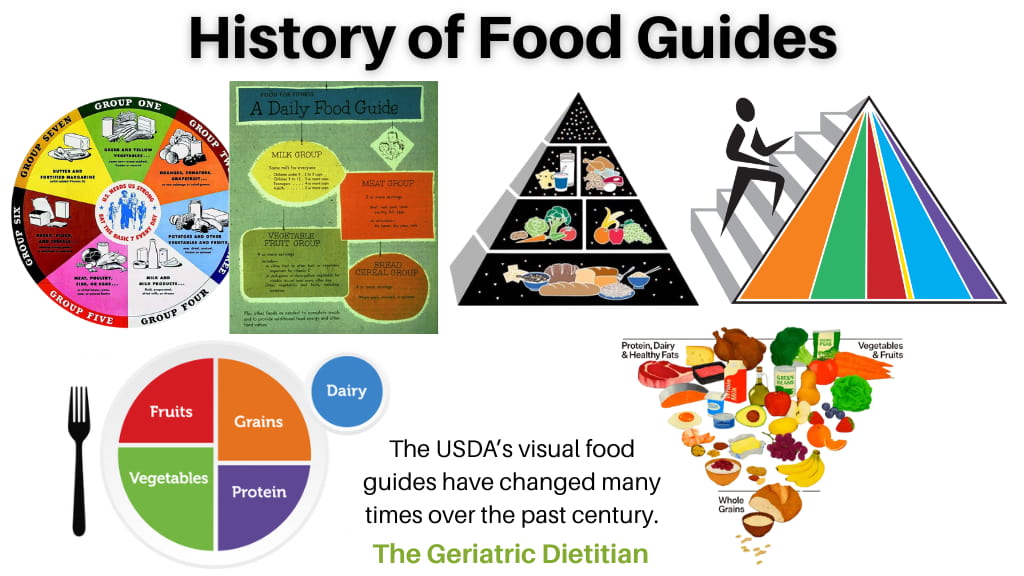
The United States Department of Agriculture (USDA) has been putting out food guides for nearly a century. Looking way back, we had the Basic Seven in the 1940s and the Basic Four in the 1950s and 1960s. And the first food pyramid was introduced in 1992.
The Food Guide Pyramid that most people are familiar with was used from 1992 to 2004. This was the food guide pyramid that I was introduced to in grade school.
In 2005 the MyPyramid Food guidance system was introduced. This version of a pyramid had vertical slices instead of stacked blocks like the previous version.
Then in 2011 MyPlate was introduced. This food guide used a plate to show how much of each food group you should consume at each meal. We’ve been using a version of MyPlate for quite some time.
So, the New Food Pyramid is a new food model- we aren’t switching from the 1992 food pyramid to this one. We are switching from MyPlate back to a pyramid. And that’s OK, food guides are always changing and they probably always will.
If you want to see a more detailed history, visit https://myplate-prod.azureedge.us/sites/default/files/2024-05/A-Brief-History-of-the-USDA-Food-Guides.pdf.
The New Food Pyramid
The return of a food pyramid style visual offers a simple way to understand dietary priorities.
The updated pyramid places a visual emphasis on:
- High quality protein
- Vegetables and fruits
- Whole grains
- Healthy fats
Refined grains, sugary foods, and ultra-processed products are visually minimized, reinforcing the idea that they should play a smaller role in the overall diet.

One of the limitations of the new pyramid is that it can be a little confusing. The whole grains on the bottom could imply that grains are “bad”. The foods shown on the guide can be interpreted as “better” than those not included.
But I think it’s important to remember that with any visual food guide- not every food can be included. This is just a guide. Think of it as a teaching tool. The Dietary Guidelines for Americans give the more nitty gritty details.
Conclusion
OK, so we have covered what is included in the New Food Pyramid and 2025-2030 Dietary Guidelines. Specifically, we discussed what you need to know as an older adult.
I know there’s a lot of commentary online about these new guidelines. So, I just want to end this article with two points that hopefully can help you to not be overwhelmed by the confusing (and sometimes political) messages being thrown around online.
Final Point #1
Most Americans (90%!) do not follow the Dietary Guidelines for Americans. This is a well-known fact. Of course, I appreciate the guidelines and focus on the transformative power of food and nutrition. But I know that a government publication doesn’t necessarily change how people eat. Which leads me to my next point.
Final Point #2
The core message of nutrition is to focus on foods that fuel your body, promote health, and make you feel good. Good nutrition has always come from food first- good sources of protein, calcium, vitamin D, lots of fruits and vegetables, and whole grains.
I would argue that most people generally know what foods they should eat more of and what foods they should eat less of (i.e. eat more veggies, eat less cake). The same goes with moving our bodies, getting more sleep, managing stress, etc. All of those good healthy messages.
I think there are bigger issues that impact how people eat, including access to food, finances, time, mental health, and more. But that is a bigger conversation for another day.
So, in conclusion, there are new Dietary Guides and a Food Guide Pyramid. Both promote healthy eating for Americans. As an older adult, your take home message is to eat a balanced diet with adequate fiber, protein, calcium, vitamin D, fruits, veggies, and whole grains.
If you want more tips on nutrition for healthy aging, check out our FREE PDF 10 Essential Nutrition Tips for Healthy Eating.