
Top 5 Tips to Become a CSG Dietitian
Are you a geriatric dietitian? You practice in geriatrics and now you want to make it official and become a CSG Dietitian?! If that’s you, you are at the right place to start. In this article I dive into how to become a CSG dietitian and I share my top 5 tips to pass the CSG exam.
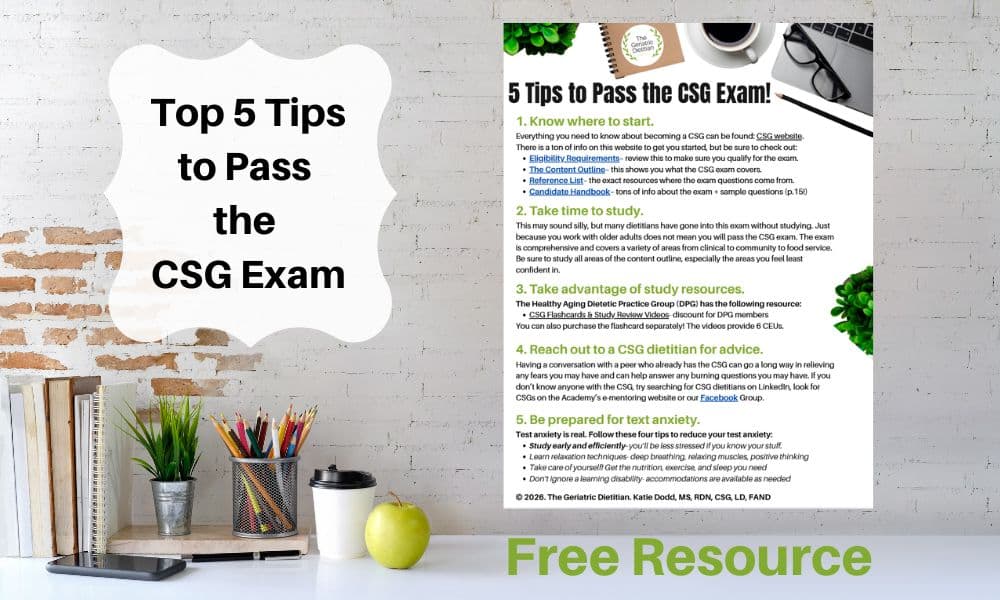
Be sure to snag my freebie Top 5 Tips to Pass the CSG Exam so you have everything you need to know in one PDF with clickable hyperlinks. You can also catch the replay of a webinar I hosted on How to Become a CSG Dietitian.
What is a CSG Dietitian?
A CSG dietitian a Registered Dietitian Nutritionist who has obtained the CSG credential. CSG is short for Board Certified Specialist in Gerontological Nutrition. This credential is offered through the Commission on Dietetic Registration (CDR).
CDR offers several different specialty credentials:
- Gerontological Nutrition (CSG)
- Oncology Nutrition (CSO)
- Pediatric Nutrition (CSP)
- Pediatric Critical Care Nutrition (CSPCC)
- Renal Nutrition (CSR)
- Sports Dietetics (CSSD)
- Obesity and Weight Management (CSOWM)
- Digestive Health (CSDH)
Some dietitians even hold dual certifications (for example, they have both the CSG and CSR).
How do I become a CSG Dietitian?
To become a CSG dietitian you must meet specific eligibility requirements, apply for specialist certification through CDR, wait patiently for your eligibility email, schedule your exam and pay the exam fees, then finally take and pass the CSG exam.
The CSG credential is good for 5 years; at which point you do have to retake the exam to maintain your credential.
Let’s dive a little deeper…
CSG Eligibility Requirements
Eligibility requirements include being a dietitian for at least 2 years and having 2,000 hours of practice experience in geriatrics within the past 5 years.
The 2,000 hours of practice experience can seem a little confusing. Does that mean 2,000 hours of direct patient care? Not necessarily. In fact, certain education and practice experience can be used to substitute up to 800 of these hours!
Practice experience for the CSG includes direct and indirect patient care.
Direct hours are those completed working in patient care settings (from hospitals to homecare). Indirect hours are those completed working in management, industry, education, and research.
The key is that you are working in the field of geriatrics. We know that dietitians work in many roles and positions. A qualified CSG dietitian might not work directly with patients but can still make a big impact in the feild!
Applying to Become a CSG
Applying to become a CSG dietitian is pretty simple.
You need to login to your CDR account (MyCDR), click on “Specialist Certification” on the left-hand menu, select the CSG drop-down, and click “Apply Now”.
From there, you just follow the instructions for completing your application! You will have to verify your specialty hours before submitting, but don’t worry- the application walks you through everything.
Once your application is submitted, CDR does their thing to confirm you meet eligibility. You will receive an eligibility email within 2 weeks. Once your eligibility is verified, you have one year to schedule and take your CSG exam.
Please note that there is no cost to apply to become a CSG dietitian. You won’t have to pay anything until your application is approved and you go to schedule your exam.
CSG Exam Fees
How much does it cost to become a CSG? At the time of writing this, it is $350 if you live in the US and $450 if you live in Canada or are using an international testing site.
You will pay the exam fees online when you schedule your exam. Your emails from CDR will explain all of the details about how to schedule your exam and where you can take it.
There is no annual fee associated CSG credential- just the exam fee every 5 years for as long as you choose to maintain the credential.
The CSG Exam
Let’s talk about the most dreaded part about becoming a CSG dietitian- the exam!
I totally get that most of you have been out of school for a long time… and the thought of taking an exam can feel a little scary. But that’s why I wrote this article- to help you pass that exam so you can proudly boast the CSG credential! You can do this.
You will take the exam at a CDR approved testing site with a proctor.
There are lots of specific rules about the testing site and taking the exam that are covered in the Candidate Handbook. The rules are in place to verify who is taking the exam and to prevent cheating. Accommodations are available if you need them.
The exam itself is made up of 150 multiple choice questions (A, B, C, or D)- 125 scored questions and 25 pretest questions. You will not know which questions are which when taking the exam.
Pretest questions aren’t used in your exam score; they are used to help create future test questions. There is a whole process that goes on behind the scenes to make sure the CSG exam has good, quality exam questions!
You will have 3 hours to complete the exam… plus 20-minutes for the introductory tutorial (meaning you get up to 20 minutes to make sure you know HOW to work the online exam!).
There is a countdown clock available if you are worried about timing. However, if the idea of a countdown clock stresses you out, no worries. You can hide it. Just keep in mind that you need to be working at a pace of 50 exam questions per hour.
As soon as you complete the exam, you will get the results! (Side Note: When I first took the CSG exam many moons ago, I had to wait for them to mail the results- it was awful!)
If you pass (yahoo!), you will get an email from CDR within two weeks orienting you to the credential.
If you fail, you must reauthorize to test again and wait at least 60-days before taking the exam again. This is OK- it gives you more time to study! If you need the credential for your job, CDR does offer a one-time waiver to the 60-day rule.
But let’s not stress about failure yet. Let’s dive into my 5 tips for passing the CSG exam.
My Top 5 Tips to Pass the CSG Exam
Without further ado, here are my top five tips! Again, you can download a PDF version: Top 5 Tips to Pass the CSG Exam.
1) Know where to start

Everything you need to know about becoming a CSG can be found on CDR’s CSG website.
There is a ton of information on this website to get you started, but be sure to check out:
- Eligibility Requirements– review this page to make sure you qualify to take the exam.
- The Content Outline– this is the outline will show you what the CSG exam covers.
- Reference List– these are the exact resources where the exam questions come from.
- Candidate Handbook– tons of info about the test, plus sample questions on page 15!
If you have any specific questions you just can’t find online, you can always call or email the staff at CDR for assistance.
2) Take time to study

This may sound silly, but many dietitians have gone into this exam without studying. Just because you work with older adults doesn’t mean you will pass the CSG exam.
This exam is comprehensive and covers a variety of areas from clinical to community to food service. Be sure to study all areas in the content outline, especially the in areas you feel least confident in.
Think about when you took the RD exam… you had to know a lot of information to call yourself a dietitian. It’s the same thing with becoming a CSG dietitian. It’s a broad practice area, so make sure you study!
I’m often asked: “What should I study?!”
And my answer is always the same… it depends on YOU. You must first review the CSG Content Outline to see what areas are covered on the exam. Then reflect, which areas are you really strong in and which areas do you need to freshen up on.
For example, when I was studying for the CSG exam, I was working at the VA as a Home Based Primary Care dietitian. I wasn’t familiar with nursing home guidelines. And it had been a while since I dealt with food service or food safety.
Your next step, after reviewing the Content Outline, is to review the CSG Reference List. These are the references used to make the exam and ones you will study from.
I made sure to read Nutrition Care for the Older Adult, freshen up on the State Operations Manual, and review the position papers.
Again, how you study is up to you and your knowledge level in each content area. But one thing you must make sure you do is this: STUDY! 🙂
3) Take advantage of study resources
I love that there are now study resources available to help you prepare to take the CSG exam! These didn’t exist when I first took the exam.
For many dietitians, the thought of taking the CSG exam can feel overwhelming. It’s been so long since you took a test. You might not even know where to start studying!
These study resources can help you are you prepare to take the exam.
Disclaimer: I have not personally reviewed these resources.
The Healthy Aging Dietetic Practice Group (DPG) has the following resource:
- CSG Flashcards & Study Review Videos– available for purchase, discount for members
- You can also purchase the flashcard separately! The videos provide 6 CEUs which is wonderful, but keep in mind when you pass the CSG exam you will be getting 75 CEUs for that credential.
The only study resource I currently reccomend is the Healthy Aging DPG tools. This tool was created by geriatric dietitians through a group I thouroughly trust.
If you do some deep diving on the internet, you may find the Mometrix Test Preparation Geriatric Nutrition Exam Flashcards. These resources have not been updated since 2018. I would not reccomend this resource unless it is updated by a geriatric dietitian at a future date.
4) Reach out to a CSG dietitian for advice
Having a conversation with a peer who already has the CSG can go a long way in relieving any fears you may have and can help answer any burning questions you may have.
If you don’t know anyone with the CSG, try searching for CSG dietitians on LinkedIn, look for CSGs on the Academy’s e-mentoring website, reach out in a dietitian-based Facebook Group, etc.
You can find lots of CSG dietitians in The Geriatric Dietitian Community Facebook group.
5) Be prepared for test anxiety
Test anxiety is real.
Many dietitians haven’t taken an exam in a long time. Taking an exam can be quite nerve wracking! Test anxiety can throw off even the best geriatric dietitians. The best thing you can do is be prepared for it.
Here are four tips to reduce your test anxiety:
- Study early and efficiently
- You’ll be less stressed if you know your stuff.
- Learn relaxation techniques
- Deep breathing, relaxing muscles, positive thinking.
- Take care of yourself!
- Get the nutrition, exercise, and sleep you need.
- Don’t ignore a learning disability
- Accommodations are available as needed.
I can’t emphasize the last bullet point enough. If you have a disability, accommodations are available. Accommodations put everyone at a level playing field. Don’t let any learning disability hold you back from becoming a CSG dietitian!
Perks of passing the CSG Exam
I am assuming that if you read this article, you are interested in becoming a CSG dietitian. I probably don’t need to sell you on why you should become a Board Certified Specialist in Gerontological Nutrition, but I did want to mention a few perks!
Here are my favorite perks:
- 75 CPE credits
- CSG credential after your name
- Potential for raise/bonus/increased rates
To maintain your dietitian credential, you need to complete 75 hours of continuing professional education credits every 5 years. One of those hours must be for ethics. But if you get the CSG you are set with your CPE (aside from hour of ethics!). I’m sure you’ll still continue to pursue CPE activities… but you no longer have to worry about logging them.
After you pass the CSG exam, be sure to start using those credentials! You earned them and they set you apart as a certified specialist in gerontological nutrition! It’s also another line on your resume that makes you stand out as the geriatrics expert.
And finally, depending on your work setting the CSG can provide leverage for a potential raise, bonus, or increasing your rates if you own your own business. It’s certainly not guaranteed, but worth looking into!
Final Thoughts
Congratulations on your commitment to pursing the CSG credential. You will no doubt be improving your own skill set and the value you deliver to older adults.
Be sure to snag my freebie Top 5 Tips to Pass the CSG Exam.
Wishing you the best of luck! And if you pass the CSG exam, be sure to reach out and let me know! I’d love to hear from you. Katie at [email protected].
Thanks Katie, for the information. It was very thorough and answered all of my questions.
I’m so glad!
Hi Katie,
I will taking the exam next year and glad to hear there are more resources for studying.
I have been working remotely due to the Corona 19 pandemic which has me thinking more about how I can help the elderly even more in their homes and community. Do you have any advice on how I can get started?
I’m glad to hear you will be taking the exam! If you are interested in working in home care, there are dietitian jobs in Medicare home care agencies and VA Home Based Primary Care Programs. Other private practice dietitians may choose to make home visits. I would recommend researching what is currently available in your community. There is always a need for more geriatric dietitians serving the elderly in their homes and community.